
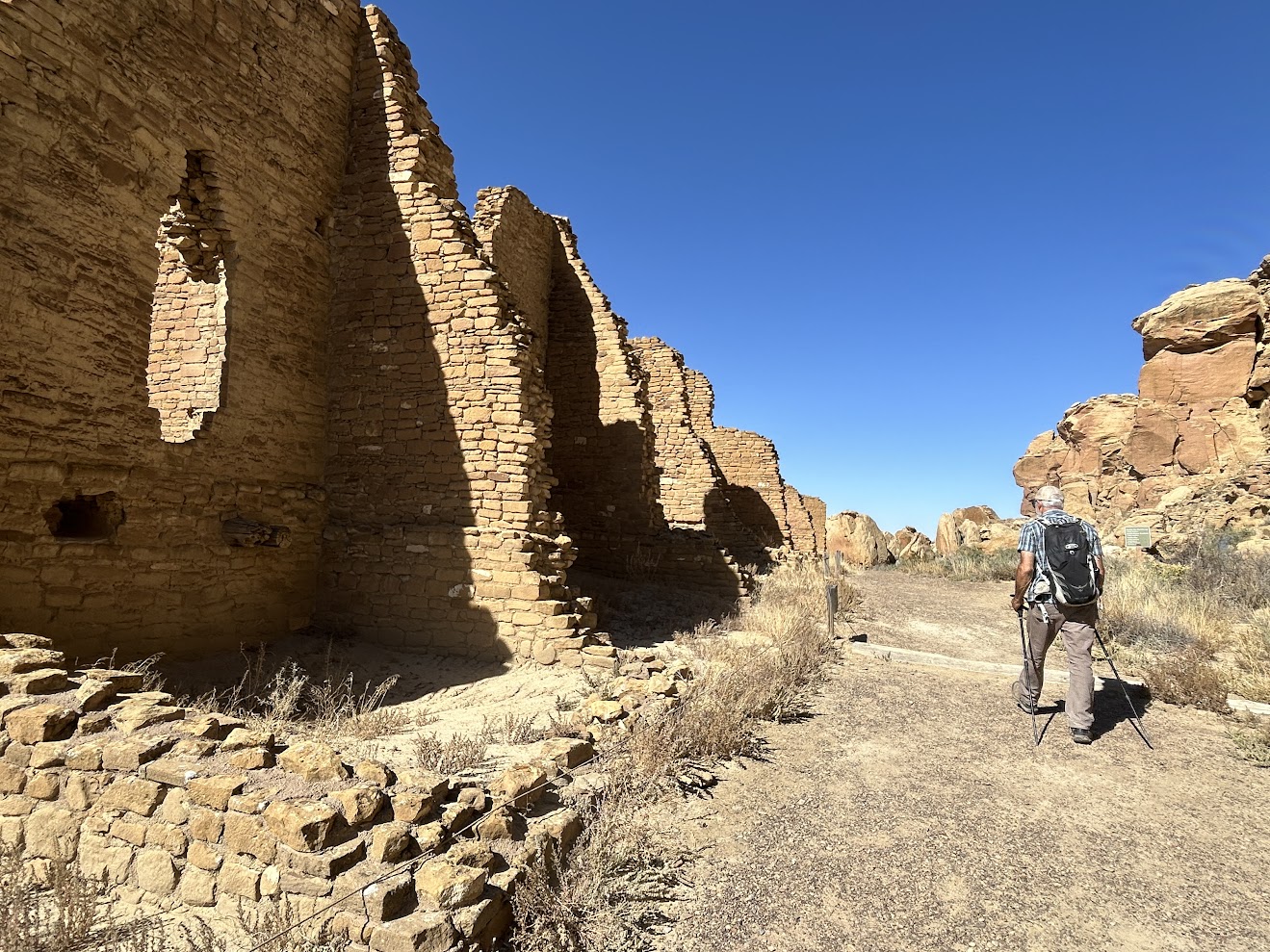

There are so many beautiful public lands in the southwestern United States. And in our three years of van living we have seen quite a few of them. We love dispersed camping on empty stretches of desert land. But we also enjoy visiting the unique national monuments and historical parks in this area.
Luckily, the southwestern US has many of these as well. National Monuments and Historic Parks tend to be less crowded than their flashier national park neighbors. In our opinion that’s all the better, allowing for a more intimate experience. In this post, we’ll share a few of our favorite “under the radar spots”.
Bandelier National Monument, NM
Bandelier is probably one of the busier place on this list. But it’s not all that busy, especially on the “shoulder seasons”. Twice we’ve rolled up on this park with no reservations and found a camping spot in their well-designed campgrounds. And there are many free boondocking spots outside the park in a pinch.

Bandelier is a large park, 33,000 acres. Most of these are back country, accessible via some lovely (strenuous) hiking trails. Believe me, the high desert around these trails is breathtaking. And there are many hidden sites, scatterings of pot sherds and other evidence of the Ancestral Puebloans along the way. These people are the ancestors of the indigenous people who live in the southwest today.

1500-1150 years ago, Bandelier was a busy place, with homes carved into the canyon walls and fields of corn and squash high on the canyon rim. If you take the time to explore cross country here, you will come across evidence of these people all over. It’s illegal to move or take these artifacts, but really wonderful to find them. The connection with the past is visceral.

The campgrounds at Bandelier are up on the rim of Frijoles canyon, while the visitor center and ruins are set deep in this beautiful canyon with a perennial stream running through it. There is a self-guided trail that follows the river and takes you past many amazing ruins. For the brave, there are ladders to climb up to Alcove house, set high in the canyon wall. Unlike Mesa Verde, you are free to explore this place on your own, which is pretty awesome, in my opinion.


Chaco Culture National Historical Park, NM
Chaco is not the easiest park to get to. You have to be a bit determined to drive the 20 miles of washboard road, impassible during bad weather. Is it worth it? We say yes! …But definitely call the park ranger station to check road conditions before you go. And definitely plan your visit for the “shoulder seasons”. Summer and winter are brutal here.

From 850 to 1250 CE, this area was a thriving regional center for the ancestral Pueblo people. There are many ruins in this wide, shallow canyon. The desert here seems harsh, but it was sustaining for the people who call it home. And it still is!
Chaco Canyon is a great place to learn more about this region’s history. Also, there are some terrific hikes here, a super dark sky for stargazing, and wildlife. What’s more, you can’t help but feel the enormity of time and space in this ancient, wild place.

The campground here is small, and there are no other close public options. So make sure you reserve a spot before you attempt to reach this wonderful place.


Chimney Rock
Chimney Rock is a small park, in another out-of-the-way location. But if you make the trek to south central Colorado, you are in for a treat. Though much smaller than its neighbor, Mesa Verde, Chimney Rock is fascinating.

The ruin, built high atop the eponymous Chimney Rock, was designed with the sky in mind. Every 18 years, a “lunar standstill” occurs between the massive peaks of the Chimney Rock formation. Archaeologists believe that rather than being continuously inhabited, this site was structured for ceremonies that occur during that lunar standstill. Pretty interesting stuff.
There is no camping available at this monument, but there are many easily found dispersed sites in the nearby forests. And be warned: the drive up to the ruins is steep and twisty. Also, the trail along the top of the monument is steep and twisty(!) All totally worth it!
If you happen to be in this area, check this place out. The views– and fascinating history– are worth the detour.


Dinosaur National Monument
This monument is another one of our oft mentioned favorites. It is waaaaay off the beaten path, spanning the Utah/Colorado border. At first, the landscape here appears arid, boring even. But Dinosaur has so much to offer.

First–of course– there are the fossils– a bonanza of Jurassic fossils that you can view in situ. Cool, right?But even cooler, is the canyon made by the confluence of the Green and Yampa Rivers. There are many trails and overlooks to explore here.
And check out the more far flung areas of the park.

We especially enjoy the Deerlodge Park area at the far eastern edge of the park. Here, we’ve watched elk swim across the river and heard their wild bugling, hiked to historic cabin ruins, waded the sandy river, and explored the rugged beautiful, trail-less terrain in every directrion.
There are developed campgrounds in this monument and even more remote spots in the northern section. In short– there is so much to do here, and such a varied experience. We just can’t get enough!


Grand Staircase-Escalante
This national monument is HUGE: almost 2 million acres of public land! It’s known for its colorful rock formations, a “staircase” that tells a continuous geologic story spanning millions of years. It is an area so vast, it has five visitor centers scattered around southern Utah.

We’ve spent many many days exploring various parts of the Grand Staircase-Escalante and have barely scratched the surface! There are amazing canyons, red rock formations, formal hikes and cross country explores, lush riparian zones, wildlife aplenty, vast wild mountain views and ancient ruins. In short: really, this place has everything Southwestern public lands can offer.

The trails and campsites that are easily accessible from pavement can be a bit crowded. But it’s easy to find the big empty if you seek it. A few of our favorite spots in this monument are The Paria River and Lower Calf Creek Falls (which can be busy. …But much less busy than Zion or Capital Reef National Parks).

And there are virtually unlimited opportunities to explore here. Many folks visit the “Big 5” national parks of Utah without giving this amazing landscape a second thought. Definitely do yourself a favor and explore “The Escalante”.


So Many Great Spots!

In writing this post, I’m reminded of all the amazing, nameless spots we’ve found in the southwest US. This area is so scenic it is really hard to find a lousy spot to set down and explore. Our advice is to stop often and pretty well wherever you feel the urge. Bring water, a map, sun protection and just head out to explore. You will no doubt discover some amazing off-the-radar spots of your own.

Discover more from Crazy Brave Adventure
Subscribe to get the latest posts sent to your email.
As a guy who grew up in this patch, I can say Dan and Perry have nailed it. Yes, the Big 5 are as spectacular (more?) than you’ve heard, but the entire region is special. There are millions of acres of Forest Service and BLM land and as the Crazy Brave Adventure duo points out, just get out and explore. Just about every canyon and mesa offers hidden gems.
Thanks, Darren! The southwest is truly an amazing place.