
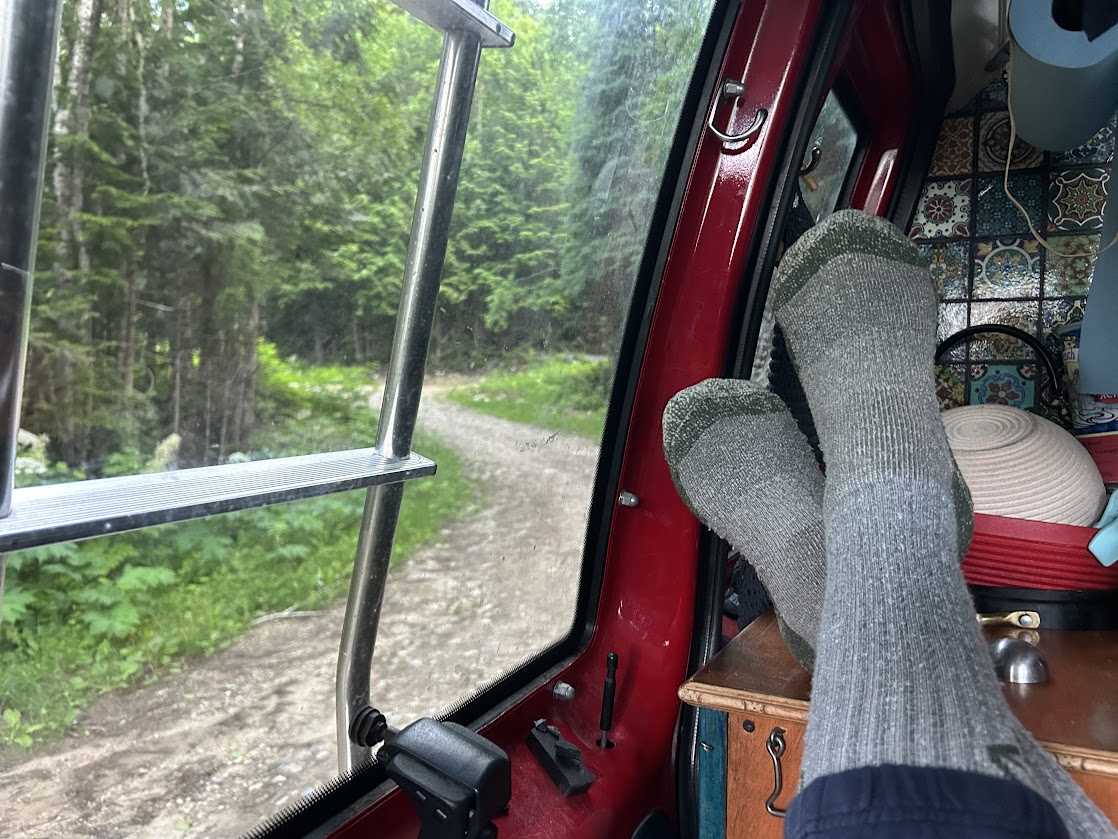

Looking at our travel maps, you’d think Dan and I were zipping across the country at a pretty good clip. But actually, our van life is on the slow side. In over three years of full time van life, we have put less than 70 thousand miles on our van. And that includes driving to Alaska, returning “home” to New England a few times, and frequent pilgrimages to visit family in Florida, British Columbia, Quebec, Ontario, Washington, Michigan, and California.

Full time van life has taught us the benefits of slow travel. We took ourselves out of the rat race. So why race at all?

You’d think slowing down would be easy, but there’s a sharp learning curve to this stuff. In this post, we’ll share some of what we’ve learned along the way.
Never Slow Enough
Before we get into the hows and whys of slow travel, a quick caveat: Slowing down is harder than it seems. In each of our years on the road, our stated goal has been to drive less and stay camped up more. How are we doing? Eh…. Not so great.

We move way too often.
Why? There’s always somewhere new to explore. And the perfect campsite is so hard to find. Sometimes, even when we’re parked up in awesome, the itchy feet find us. Also, our no frills, van is not equipped for long stays. After a week of camping, we really (really) have to resupply.

We are in awe of the folks who stay in place for a few months, in BLM Long Term Visitor Areas or even make the 14 day limit on public lands. It’s rare we can commit to a full week in one place!
Our van life goal is always to slow the heck down. And there are many reasons for that.

3 Benefits of Slow Travel

Cheaper Living
Whatever your situation, moving costs money. Every time we pick up and drive, we are feeding our voracious gas tank.

Add to this the inevitable stops: groceries, laundry, maybe a restaurant or museum. We try to budget for these things, ducking into Walmart to pick up a few necessities from our running shopping list. But the truth is, once we’re in a store, all bets are off. We end up with a bunch of extra “necessities.” Maybe you do too. Truth is, the slower you travel, the cheaper your van life will be.

Deep Knowing
It is impossible to fully know a place. This aspect of van living was a surprise. And it’s a bit frustrating, too (at least for those of us who want to see everything). No matter how long you stay in an area, there is always another trail, another Forest Service Road, an unexplored park or untried food truck. No way around it, if you’re a nomad, you’re just scratching the surface.

But if you breeze through an area, this issue is compounded.
Here’s a travel secret it took us a while to learn: The best places are rarely the ones that are in the guide books and tourist sites. They are low key places the locals know, lightly hiked trails and little-visited cultural features. It takes a while to suss these out. Staying put gives you more time to learn an area.

Less Burn Out
Travel burn out is real. The more time you spend setting up and taking down your “camp” the more like work van living becomes. Add to that the many travel decisions and “where to now?” discussions, and it gets a little old.

Do yourself a favor and just….. be awhile. Stay put and watch the way the moonrise shifts across the sky.

Hike off in every direction until you feel you understand the ecology of your camp.

Learn the local flora and fauna.


Just, relax and live a while. If you are constantly setting up, taking down, moving on, finding camp, setting up…. etc., van life will start to feel as hurried as life back in the house.

How to Slow Down on the Road
So yeah, in our opinion, slow travel is the key to a happy van life. Here are a few tips to help you take some pep from your step and settle in for the long haul.
No Interstates
This is a biggie. The interstate system is designed to get you from Point A to Point B quickly, bypassing almost everything worth seeing along the way. It is convenient for travelers who need to get somewhere fast. And yeah, those rest areas can be nice overnights. But they also remove the chance to experience the land around you. On the interstate, you can’t stop and explore. You can’t pull over to check out a crumbled-down cabin or a sudden view. In short, we recommend you only interstate when you have to. Like, really have to.
Always choose the more interesting, scenic, historic, empty route. The cool stuff is NEVER on the interstate. And if it was, you wouldn’t be able to stop and check it out anyway.

Drive Short Distances
Sometimes you just have to get to where you’re going. But other times — most times — there is no reason to put yourself through a long day of driving. It is really wearing — and wearying — to drive for long stretches.

It took us a while to learn this one. But nowadays, we rarely drive more than a few hours at a time. And that is exactly how we like it. Not only does this approach keep us chipper, it allows us to experience places that we would have passed right by. We’ve discovered many of our favorite spots because they were within a few hours’ drive. Short drives promote exploration — and allow for serendipity!

Dawdling Speed
Why hurry? These days, it’s rare that we reach the speed limit. Not only does this save on gas, it gives us time to notice the places around us. We are constantly pointing out “emergency overnight” spots along the way (though we really never use them). And we have time to notice interesting off-shoots and Forest Service roads.

While we drive, the passenger always has the state Benchmark Atlas open to point out landforms. And also to investigate where all those little roads go. Slowing down deepens the travel experience. In general, we recommend you maintain an nice, even dawdling speed. And if people pass you, so what?

When in Doubt, Check it Out!
This is a goofy saying we made up to help us slow down and enjoy the drive. If we pass something that seems interesting: a roadside marker, trail head, art installation, public campground, mountain, river, forest service road, etc., we stop and check it out. Basically, if we think we might want to stop, we do. More often than not, this leads to really (really) slow travel. Because, truly, there are just SO MANY COOL THINGS out there!


Stop for Lunch
Don’t eat on the run.

A lunch stop is a chance to get to know a place at the local level. We look for state or neighborhood parks for lunch. Often, these are really sweet finds. And it’s nice to take a little break, make a meal and explore a bit.
This is where bag salads, tacos, wraps and sandwiches really shine. They take little time to prep and are healthy and light.
Bonus, if the clean up is easy.
Yeah, we do end up snacking on the road, but we try to stick to healthy snacks like apples and homemade popcorn. So when we stop mid-drive, we are ready for a real meal.

Work and Hobbies
Soooo, what do you do with yourself when you park up?
It’s easier to stay put and relax if you bring some hobbies along with you. It’s not all exploring and hiking (though, in our van life, there is a lot of that).

Dan works full time online. He also paints, plays guitar and video games, and putters about improving our systems (almost another full time gig!)


I go off rockhounding, but also work on our photography posts, videos and website. Sometimes I write fiction or poetry, or research local ecology and history.


We take time to cook relatively complex meals, ride bikes together (occasionally). And we play scrabble and read. Even do yoga… sometimes(!)


In short, wherever we are, we are never bored…. though some might consider us boring 🙂
Build your Van for the Long Haul
We did not do this. Instead, we built on the cheap, starting van life with a 48 liter fridge, a Jackery Power Station, and a flimsy set of portable solar panels.

Also, we made room for only 10 gallons of fresh water. This is just not enough for a long stay.
Since then, we’ve added a lot more power capacity: a hundred amp hour lithium battery, 400 watts of panels permanently affixed to the roof, plus another 200 watts of portable panels.
But our water storage is what it is. Likewise with the fridge. We always run out of fresh food — veggies and cream and protein — within a week. And, yeah, we could eat tuna, and canned beans, mac and cheese and pasta for a long time after.

But it’s rare that we do that. Water of course, is a nonnegotiable. If you’re in the planning stage, we recommend building your van for a longer stay… if you have the room and money to do so.

Plan your “Chore Day”

When you do have to pick up and go, be organized about it. We like to do all the required things in one go: Propane refill, groceries, laundry, showers, water, etc.
It’s a bit brutal. But at least when we are done, we are done. Then we can mosey on down the road and stop somewhere awesome with a full re-set.

Google/Apple maps help you plan these stops wherever you are. And a running grocery list lessens the chance we’ll end up buying too many extras. Walmart type stores are a time saver in that we can buy camping and automotive gear, water, food, beer and kitchen equipment all at once.
Also, it helps to eat well before you start your chore day. You’ll save time and money if you aren’t super hungry in town. Trust me on this one.

Van Life is Not a Vacation
In short, van living is not the same as van vacationing (Van-cationing?). And if you act like it is, you will totally burn yourself (and your wallet) out. So, slow the heck down! Take the back roads and mosey a little. It’s not always easy to do, but if you can swing it, slow van travel is the way to go.

Discover more from Crazy Brave Adventure
Subscribe to get the latest posts sent to your email.
One thought on “How to Get Nowhere Fast: The Benefits of Slow Van Travel”