

It’s hard to believe we’ve been at this crazy brave thing for a full four years now. But indeed we have.
And a lot has happened in our fourth year on the road.
First off, we’ve changed.

In our first few years, we were climbing a steep learning curve, updating our power systems and adding storage (then more storage, then even more storage) to our little van home.
We were still learning the ropes, got snowed in Utah, had to wait in the Wyoming back country for the roads to dry out, and to dig ourselves out of spring mud on a mountaintop in Kentucky. We accidentally drove on a few ATV trails too (Ooops!)

We found we loved exploring off the beaten path in the desert west. And we tried our hand at stealth camping in Florida…which we didn’t love so much.

Our 3rd year brought a lot of changes. My stepfather died, and our travel buddy, Milo too. And much of the shiny newness of van travel felt more like regular life to us, full of ups and downs and daily routines. We mourned, and explored and felt like pros.

So of course, our 4th year, threw more big changes our way.
A Year of Constant Change and Constant Motion
We started our fourth year in the north, in Yukon, at the tail end of a truly wild and amazing summer journey. Then my mom got sick and we headed back to Florida. Our nomadic lifestyle allowed me to be with her as she died, and to remain with family in Florida as long as we needed. I spent a lot of time, cleaning out the family storage unit, sorting through old pictures and feeling the feels. (The picture on the right is me and my mom in 1967)


Then Stevan, our beloved “vaguely menacing” Econoline van, went to a new home. (We like to say we gained a friend rather than lost our little home.) And we bought a bus!

The next few months were a strange, frenetic mix of grieving and building. It took us about two months to turn our little bus into a home.


And then we set out once again, on a hectic coast to coast to coast journey. Which brings us to Newfoundland and the end of our fourth year as full time travelers.

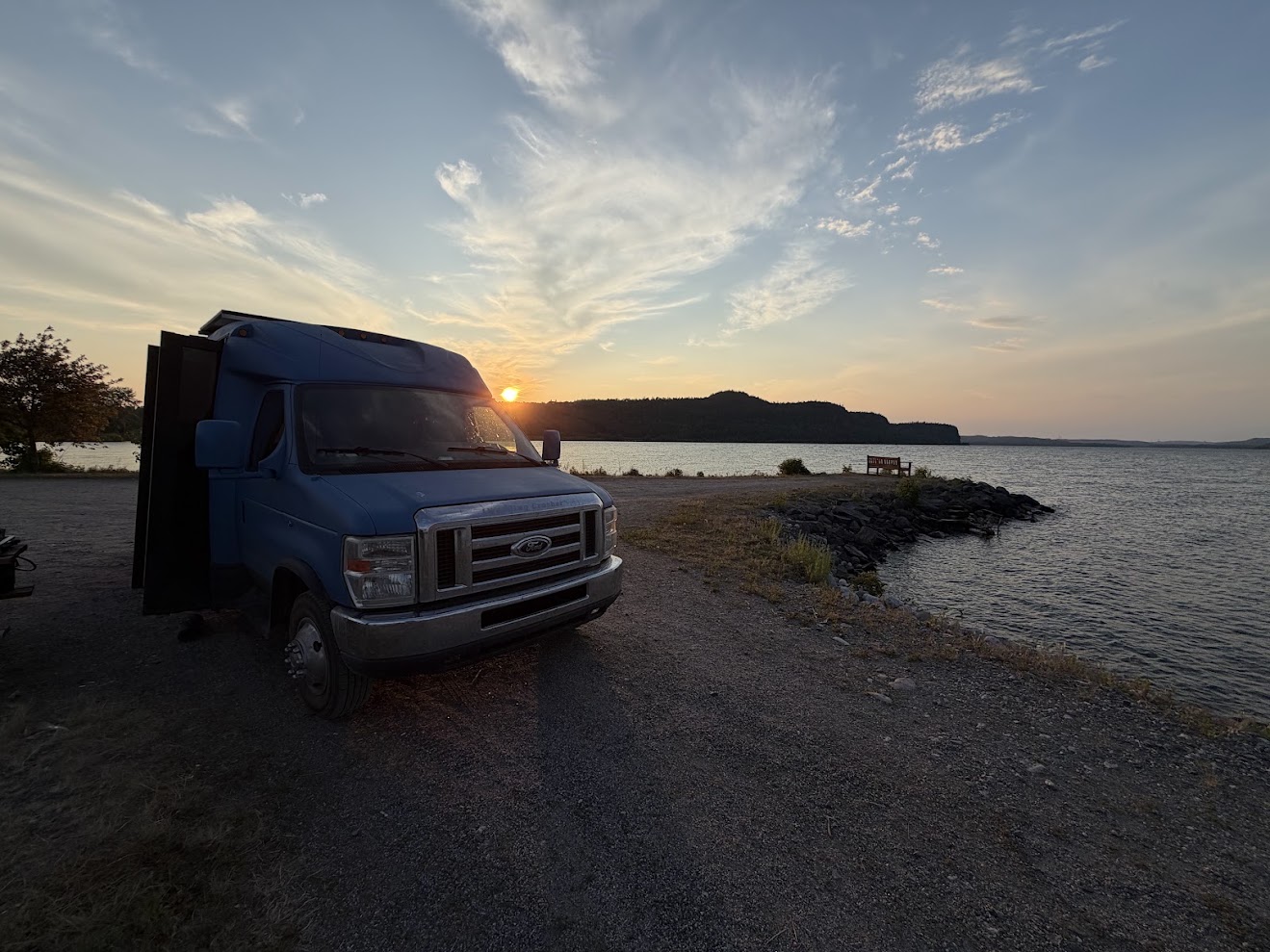
Our little bus is a cheery blue now. We call her “the blus” most of the time. But she has an actual name: Babe.

And we have a name too, a new one. No more “Crazy Brave Adventure” because, really, this lifestyle doesn’t feel so crazy or brave anymore. It’s just our life, full of ups and downs and roads more or less traveled. And we are just rambling around as usual, following our bliss– er Blus– wherever she takes us.

Year Four By the Numbers
We’ve compiled a few stats
US States Visited: 16
Canadian Provinces Visited: 6
Individual Camp Spots: 138

Camp Spots Year 4
We aren’t particularly good about tracking our expenses. But we do track each of our camp spots… mostly so that we can remember them. (It’s harder than you think after a while.) But also so that we can provide a resource for others. Each pin on our maps provides a little info about the spot– cost, amenities, trails, etc. If you want to check out our maps from this or other years, they are pinned to the side bar on our “about us” page. And our current Year 5 map is on the footer at the bottom of our site.

We tend to reflect a bit on our “Vanniversary”.
We posted a bunch of stats (including some from Milo) on our Year 1 Vanniversary. In Year 2, we shared our 10 favorite camping spots. In Year 3, we tried to summarize three full years of nomadic living, and what it meant to us. This year, we are talking camp spots.
Camp-Finding Pros?
We think we have “camping” dialed in now– at least our preferred style of camping. Truly, each nomad has their own way of doing it, and we don’t begrudge anybody their lifestyle choices. But highly rated sites on apps like Campendium and iOverlander often leave us cold.

We tend to prefer wild spots rather than city or suburban camping/parking. Places removed from the crowd with few services suit us fine. And we’ve only stayed in one Walmart in four years of nomadic living.
Now that we are in a bright blue bus, stealth is out of the question. Which is okay. We park where we are allowed and don’t try to get away with anything. And we have never gotten “the knock”.
Generally, we don’t reserve sites or plan much ahead. If we are heading somewhere new, we look at the apps and maps the morning of, and plan where we might end up. Along the way, we keep the apps open and check out the spots along the way. If we like them, we just settle in. Losing the “where are we going to stay?” worry is what separates our road hardened selves from the newbies we once were.
As veteran nomads, we try to get somewhere by early afternoon and hardly ever drive more than a few hours a day unless we really have somewhere to be.
…Which happened more than usual this year. We didn’t track our miles, but let me tell ya there were a lot of them!
So, without further ado, here are our year four camp spot stats:
Total Number of Camp Spots — 138
We moved waaaay too fast this year. And we knew it. But we just couldn’t slow down. We had scheduled meet ups in three corners of the continent, and one more in the middle, too. So we did a little more rushing around than usual.
We made a playlist for this wild zig zag year of driving. It’s called Coast to Coasting. Because that’s what we did: Zipping from the wild northwest of Yukon to Florida. Then to BC, and alllll the way across the country to Newfoundland. Whew! Aside from our stay in Florida, we didn’t wake up in the same place more than five days in a row.
So much for slowing down.
Anyway, here’s a breakdown of our camp spots:
Free Camping Spots/Boondocking — 55
This year, more than a third of our camping was free. Most of these spots were dispersed boondocking sites off dirt roads on public lands. This is our favorite way to camp. Both Stevan and Babe are worthy boondocking rigs, with solar power. No hook ups needed here.


But this category also includes a few free federal campgrounds, and a few random parking lots as well.


We stayed in a few rest areas too, both beautiful and awful.


Our least favorite free spot was a bike trail parking area just outside Quebec City, Quebec. People were coming and going all night long, doing we’re not sure what. But we never felt unsafe there.

Some boondocks were beautiful, but too crowded for our tastes.

Our favorite boondocking spots of the year? We’ll share those in our next post.
Federal Campgrounds — 22
We stayed in 22 federally-managed campgrounds. This category includes National Forest and Bureau of Land Management (BLM) campgrounds, National Recreation Areas and Corps of Engineer (COE) campgrounds. These spots usually cost between $5 and $30. Each forest or management area has its own fee schedule, and some are outsourced to venders who tend to charge more.


We are lucky to have the lifetime interagency Senior Lifetime Pass, which cuts camping fees at these national campgrounds in half. A HUGE savings. If you are 62 years old or older, get yourself one of these. It makes living on the road significantly more affordable. And it opens up many more camping options.
State or Provincial Parks — 19
To tell you the truth, we aren’t huge fans of state and provincial parks. They are usually more “developed” (and more expensive) than we prefer, with sites close together and more amenities than we need. And to be honest, they often feel a little suburban to us.
In addition, many state parks require reservations ahead of time, which is a nonstarter for us. And more trouble than it’s worth as we don’t need hook ups or pavement or many of the other things that state parks offer.

Buuuut, there are times when these places come in really handy. If you need showers or laundry, for example. Or if you are in a part of the country that has few wild boondocking opportunities. If it’s a choice between a parking lot and a state park, we often choose the park. But we grit our teeth when we do it.
Municipal/Town Parks — 15
This is a category we didn’t even know existed before we hit the road. But we actually stop over in municipal or town parks with some frequency. These parks vary quite a bit. Some are manicured, with full hook ups, pools and playgrounds, showers and shoreline. Other’s are just a flat space in the center of town near a busy intersection. They can be free– or cost as much as a typical RV park.

Usually, though, municipal campgrounds are pretty affordable. And we like to support the small towns we visit when we can. Our long stay in Canada this summer definitely contributed to this stat. Many small towns in Northern Quebec and Newfoundland have community camping areas with modest fees.

Moochdocking– 8
We spent a lot of time with family and friends this year. And “Moochdocking” (camping in a loved one’s driveway or on their land) is a great way to visit. We moochdocked in four different states and one province, including a long stay at my brother’s house over the winter. (We stayed inside the house at that one.)

Private Campgrounds — 5
Five is a pretty high number in this category for us. We rarely need the services private campgrounds provide and we don’t enjoy the amenities. Private RV parks are like crowded little neighborhoods, “houses” parked side by side with little room between them. But we’ve learned to be pretty flexible. And RV parks are expecially helpful when you’re expecting torrential rain or extreme cold or just need to stop driving for the day.

Ferries and Ferry Lots — 4
We spent quite a lot of time on ferries this year. We ferried from Skagway, Alaska to Bellingham, Washington in September. And from Port Angeles, WA to Victoria, CA, much later in the year. We ferried across the Sagueney River in Quebec and took a long, wild ride on a ferry up Quebec’s Cote Nord. And then we took another ferry from Blan Sablon, QC to St Barbe, Newfoundland.
This year, we also slept in a ferry lot– twice in fact!– to catch an early morning sail. Honestly, I love everything about ferries, and parking up in a ferry lot is just fine with me. There are 24 hour bathrooms, other travelers to chat with and– in the case of both Skagway and Victoria, cities to wander.


Tent Camping — 4
Here’s a new one. This year, we went on a backpacking trip with our kids and extended family. Eight of us, tromping through the wet, beautiful coastal lands of Newfoundland on the East Coast Trail.

It was harder than I remembered, backpacking. But it was wonderful.
Babe waited at a trailhead parking lot while we spent four nights in our old backpacking tent …which kicked the bucket on our last day out. Time for a new tent, maybe?


Motel — 1
This overnight was out of necessity when our van broke down in New Mexico. It was a scary, worrying time. A motel is not our favorite scene, but sometimes, ya just gotta.

National Parks — 3
Almost all the things we said about state parks can be said about national parks. Plus: crowds. Lots and lots of crowds. The benefit to national park camping, of course, is the parks themselves. Staying inside the park gives you access to all the trails and beautiful places.

So, yeah. We did this a few times: Once at Bandalier National Park while visiting with our kids, and twice at Terra Nova National Park in Newfoundland, Canada.
And you bet we made sure to take advantage of the awesome trails while visiting these places.

Paid Parking Lots — 2
Did you know it’s possible to overnight in a paid parking lot? In a pinch– especially in an urban pinch– this is a good option to keep in mind. We did this twice in our fourth year on the road. Once was out of necessity; we were dropping off our youngest at the airport at 5AM in St John’s, NL. The bus has an extra bed (well, a long couch, anyway). So why not stay in the long term lot? It wasn’t great, but it saved us a whole lot of trouble in the morning.
Our second paid parking stay, in Victoria, BC, was close to an awesome family wedding we were attending. It was just $25 CD a day, much better than a fancy hotel or a long drive into town. Between proximity to the festivities and to all this lovely city had to offer, it was one of our favorite camp spots of the year.

Van Fests/Meet ups — 1
We only made it to one meet up this year, Peace, Love, and Vans at Hummingbird Ranch in Colorado. But what a time we had! We’d totally do more of this… if we could get our planning in gear.
If you are a current of wanna be vanner, nomad or traveler, we highly recommend spending some time among your peeps at a meet up. Maybe we’ll see you there!


What a Year!
Aint gonna lie, our fourth year on the road was challenging. Between grief and joy, saying good bye to one home and building another, the days just wallowed by.
We are lucky that some things, the routines of travel, the flexibilty to shift — and shift again–are just our everyday vibe now. Because adjusting to all these changes could have been really rough. But as it was, the nomad part of the year was the easiest, less emotionally fraught part by far.
Our little Blus is much cozier than our (wonderful but much smaller) van. We spend a little more time inside now that we have an inside booth to sit in. (Not sure this is a totally good thing…)And the 20 extra gallons of water and muscular solar set up help. And I really appreciate not having a huge set up/take down routine.

But we are still learning what Babe can do and what she can’t. Hills are more challenging now, and we have to pick our routes with a little more care.
Same goes for the forest service and BLM roads we love. While in northern Quebec we got stuck in deep sand– in a campground! But the trade offs are worth it and we adore our new home.

Keepin’ on Keepin’ on
And we aren’t done yet! We always said we’d continue our wanderings until we don’t want to any more. And that day has not yet come. We love the constant “new” of life on the road, catching every sunset (and most sunrises too), managing our resources, and even the slight discomforts, of nomad living.
After four years on the road, nomad life is just “life” these days. And we wouldn’t have it any other way.
Our 4th Year in Selfies


Discover more from Following Our Bluss
Subscribe to get the latest posts sent to your email.
One thought on “Nomads by the Numbers: Celebrating Our 4th Year on the Road”